

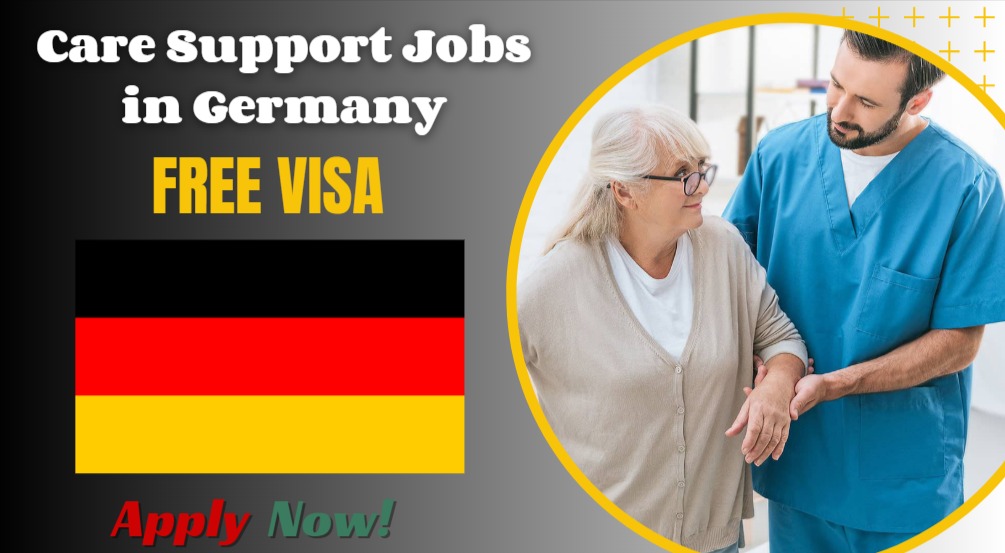
Care Support Jobs in Germany with Visa Sponsorship: Care support jobs in Germany offer a viable and structured pathway to employment and residency for international workers. Due to a severe and ongoing shortage of qualified caregivers, Germany has created specific immigration routes to attract skilled professionals to this sector. This guide explains the roles, the dedicated visa process for caregivers, and how to secure a position with legitimate sponsorship.
Understanding Care Support Roles in Germany
In Germany, direct care roles are typically classified under the profession of “Altenpflegefachkraft” (geriatric nurse) or “Pflegefachkraft” (general nursing professional). Since 2020, these titles have been unified under a new generalist training model. For support-level roles, the key position is:
-
Pflegehilfskraft / Altenpflegehelfer:in (Care Assistant/Aide): This is the primary support role. They work under the supervision of qualified nurses (Pflegefachkräfte) to provide basic care, including assistance with daily living activities, mobility, and basic medical tasks.
The Official Visa Pathway: Triple Approval Process
Germany does not have informal “sponsorship.” Instead, it has a formal, government-regulated process for hiring non-EU caregivers. To work legally, you must successfully navigate a three-step approval chain:
1. Recognition of Your Foreign Qualification (Anerkennung)
This is the mandatory first step. Your foreign nursing or care assistant qualification must be officially recognized as equivalent to the German standard.
-
Process: You submit your certificates, transcripts, and proof of work experience to the responsible German authority (often the regional office of the IBB (Institute for Vocational Training) or the state’s nursing chamber).
-
Outcome: You will receive a “Statement of Comparability” or a decision on partial equivalence. You may be required to complete compensatory measures (Ausgleichsmaßnahmen), such as adaptation courses or knowledge exams, to fully qualify.
2. German B1 Language Proficiency
This is non-negotiable. To work in care and obtain a visa, you must prove German language skills at the B1 level of the Common European Framework of Reference for Languages (CEFR). A certificate from an approved institute like the Goethe-Institut or Telc is required. You cannot start the visa process without this.
3. A Concrete Job Offer from a German Employer
Once you have your recognition decision (or are in the final stages) and your B1 certificate, you can seek employment. The employer must be a recognized care facility (e.g., nursing home, hospital, home care service).
The Visa Itself: The Skilled Worker Visa for the Nursing Profession
With the above three elements in place, you apply for a residence permit for the purpose of skilled employment.
-
Process: Your German employer drafts a contract and applies for pre-approval from the Federal Employment Agency (Bundesagentur für Arbeit). The agency checks that your salary meets the local standard and that the role is genuine. Once approved, you apply for the national visa at the German embassy in your home country.
-
Benefits: This visa leads to a secure residence permit and is a direct path to permanent settlement (Niederlassungserlaubnis) after 4 years (or potentially less with higher language proficiency).
Step-by-Step Action Plan for Applicants
Phase 1: Preparation (From Your Home Country)
-
Gather Documents: Collect all diplomas, transcripts, work experience letters, and passports. Have them officially translated into German by a sworn translator.
-
Apply for Recognition: Submit your recognition application to the competent German body. This process can take several months.
-
Learn German Intensively: Enroll in courses targeting the B1 exam. Achieving B1 is the single most important factor you control.
Phase 2: Job Search & Application
-
Create a German-Style Application: Prepare a CV (Lebenslauf) with a professional photo and a tailored cover letter (Anschreiben).
-
Where to Apply:
-
Job Portals: Arbeitsagentur.de (use keyword “Pflegehilfskraft“), StepStone.de, Pflegejob.de.
-
Employer Directories: Search for “Seniorenheim” (nursing homes) or “Pflegedienst” (care services) in your target city/region.
-
Recruitment Fairs & Agencies: Specialized agencies like MakoBS or Care.com operate internationally.
-
Phase 3: Visa Application & Relocation
-
With your signed contract and pre-approval from the Employment Agency, apply for your visa.
-
Upon arrival in Germany, register your address, get your residence permit card, and obtain your professional practice permit (Berufserlaubnis) from the local health department.
Key Requirements & Realities
-
Salary: Governed by collective agreements. Gross entry-level salaries for care assistants typically range from €2,600 to €3,100 per month, plus allowances for night/weekend shifts.
-
Working Conditions: Shift work is standard. The work is physically and emotionally demanding but highly respected.
-
Warning – Scams: Be extremely cautious of any agent or employer asking for large upfront payments for “guaranteed visas” or “job placement.” Use only reputable, transparent agencies.
-
Future Prospects: After working as an assistant, you can often access state-subsidized training to become a fully qualified Pflegefachkraft, which significantly increases your salary and career options.
Final Summary
Care support jobs in Germany with visa sponsorship are part of a formal, government-supported immigration program designed to address the national caregiver shortage. Success is not based on simple employer sponsorship but on a rigorous process of qualification recognition, B1 German proficiency, and securing a job offer.
Your path is clear:
-
Start your recognition process.
-
Achieve German B1 level.
-
Find a German employer who will support your visa application.
This route offers not just a job, but a stable, long-term career and life in Germany. Begin by visiting the official portal “Anerkennung in Deutschland” to start the recognition process for your qualifications.
Disclaimer
This job information is shared for educational and informational purposes only.
Any discussion of visa categories is based on general immigration laws and publicly available information.