

Spain Fish Packing Jobs for Overseas Applicants: If you are looking for fish packing jobs in Spain with work permit sponsorship, you are targeting a sector with significant opportunities in the country’s food processing industry. Spain has one of Europe’s largest fishing fleets and a massive seafood processing sector, particularly in coastal regions like Galicia, Andalusia, and the Canary Islands. These facilities require workers for processing, packing, and preparing fish and seafood for domestic and international markets. This guide provides comprehensive information on fish packing opportunities in Spain, including job duties, requirements, how to find positions, salary expectations, and work authorization options for overseas applicants.
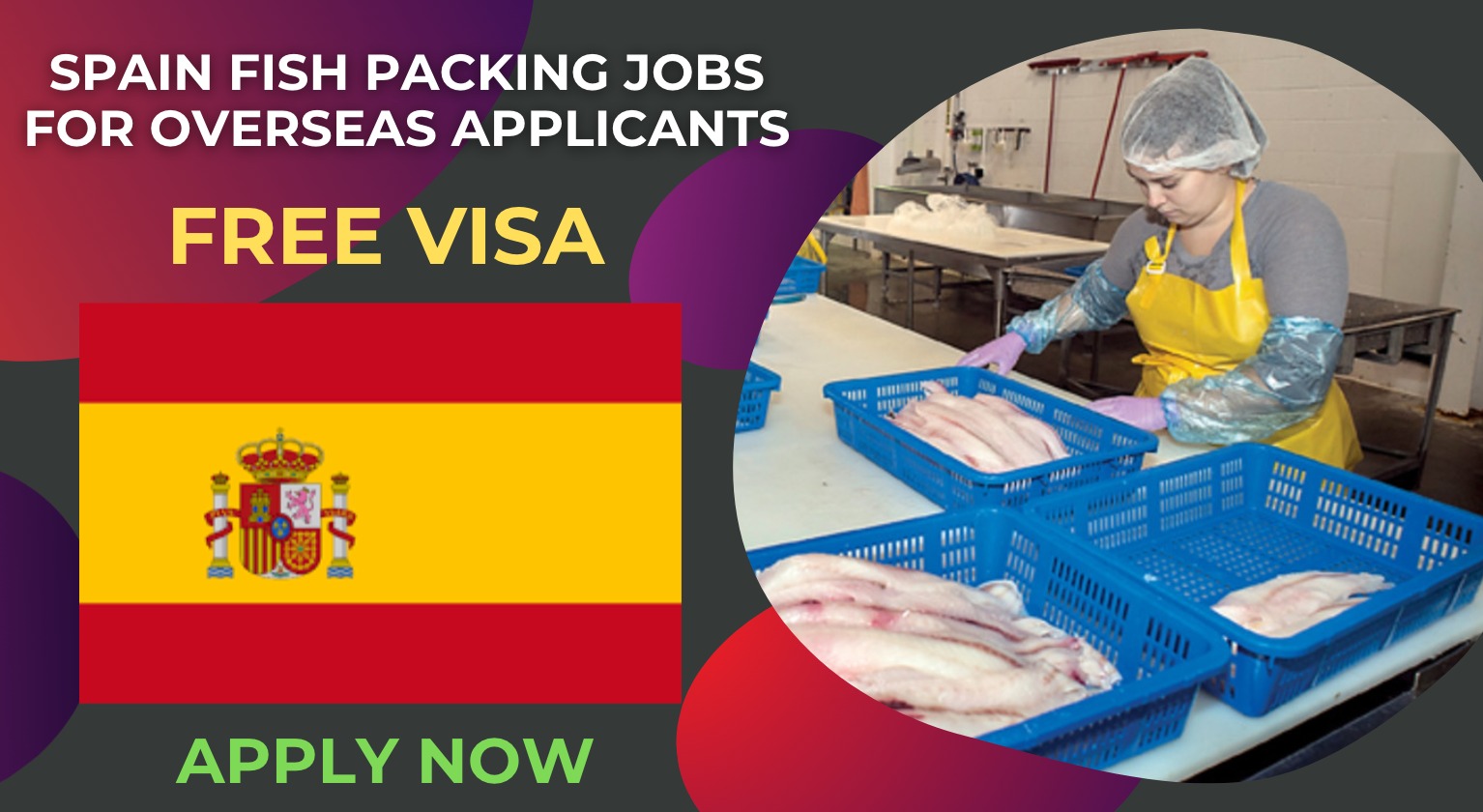
Understanding Fish Packing Jobs in Spain
Fish packing workers, known as operarios de procesado de pescado or trabajadores de la industria pesquera in Spanish, are essential to the seafood processing industry. Spain’s fish packing sector ranges from small family-owned facilities to large industrial operations serving major supermarkets and export markets.
Typical duties include receiving and sorting fresh fish and seafood upon arrival at processing facilities. Workers clean, gut, and fillet fish according to product specifications, requiring good knife skills and attention to detail. They package fish and seafood in various formats including fresh, frozen, and vacuum-sealed, then label packages with product information, weight, and expiration dates. Many workers operate packing machinery such as sealers and vacuum packers. Maintaining cleanliness and hygiene standards in processing areas is critical, as is following food safety protocols including temperature control and sanitation. Workers also perform quality control to ensure products meet standards and load packed products for shipment.
These positions are physically demanding, requiring standing for long periods, working in cold environments, performing repetitive tasks with good manual dexterity, and working quickly to meet production targets. The work can be fast-paced, especially during peak fishing seasons when large catches arrive for processing.
Major Fish Packing Regions in Spain
Spain’s fish processing industry is concentrated in coastal regions with major fishing ports and strong seafood traditions.
Galicia, in northwestern Spain, is the heart of the Spanish fishing industry, accounting for a significant portion of national seafood processing. The ports of Vigo, A Coruña, and Marín are major fishing centers with extensive processing facilities. Vigo is one of Europe’s largest fishing ports, with a huge concentration of fish processing companies. The region processes enormous quantities of white fish, tuna, octopus, and shellfish. Fish packing jobs are plentiful, particularly in the Vigo area.
Andalusia’s Atlantic and Mediterranean coasts have significant fishing activity. The ports of Huelva, Cádiz, and Algeciras process fish from local fleets and international waters. The region specializes in tuna, anchovies, and various white fish. Processing facilities range from small traditional operations to modern industrial plants.
The Canary Islands have a substantial fishing industry serving local and export markets. The ports of Las Palmas de Gran Canaria and Santa Cruz de Tenerife are important fishing centers. The islands’ strategic location makes them a hub for international fishing operations. Fish packing jobs are available year-round, with seasonal variations in activity.
The Basque ports of Pasaia, Bermeo, and Ondarroa have a strong fishing tradition. The region processes significant quantities of tuna and other species for canning and fresh markets. The Basque fishing industry is known for quality and innovation.
Catalonia and Valencia along the Mediterranean coast have active fishing ports including Barcelona, Tarragona, and Valencia. The industry processes local catches and fish from broader Mediterranean fisheries, with processing facilities ranging from small to medium size.
Salary Expectations for Fish Packing Workers
Based on industry data, fish packing workers in Spain typically earn between €1,200 and €1,800 per month, depending on experience, location, and type of processing.
Entry-level workers with no experience earn €1,200 to €1,400 per month, receiving training on basic tasks while learning the trade. Experienced packers who work efficiently at processing and packing earn €1,400 to €1,600 per month. Skilled processors with filleting abilities, quality control responsibilities, or machinery operation skills earn €1,600 to €1,800 per month.
Several factors affect pay levels. Region plays a significant role, with Galicia typically having the highest concentration of jobs and competitive wages. Previous fish processing experience commands higher pay. Workers with filleting skills or machinery operation earn more. Night shifts and early morning starts may attract premium rates. Peak seasons may offer overtime opportunities that increase total earnings. Larger industrial plants often pay better than small operations.
Spanish fish packing employers may provide additional benefits including social security contributions providing access to healthcare, paid vacation pro-rated for contract duration, overtime pay, meal allowances or subsidized canteens, protective clothing and equipment, training on food safety and processing techniques, and performance bonuses in some facilities.
Requirements for Fish Packing Jobs
Essential requirements include physical fitness with the ability to stand for long hours, perform repetitive tasks, and lift boxes up to 20 kilograms. Manual dexterity with good hand skills for handling fish and operating equipment is crucial. Hygiene awareness and understanding of basic food safety principles is essential. Reliability with consistent attendance and punctuality is critical in production environments. Teamwork and ability to work collaboratively with other processing staff is important. A strong work ethic and willingness to work hard and maintain production pace is valued. Flexibility and availability for shifts, including early mornings and weekends, is necessary.
Spanish language skills are important for most fish packing positions, as communication with supervisors and colleagues will be in Spanish. Basic Spanish is essential for understanding instructions, safety protocols, and quality standards. In Galicia, some knowledge of Galician may be helpful, though Spanish is universally understood. Learning Spanish will significantly improve your prospects and ability to integrate.
Preferred qualifications include previous food processing or fish packing experience, knowledge of fish species and processing techniques, food safety certification, knife skills for filleting, understanding of cold chain requirements, and ability to work in cold environments.
How to Find Fish Packing Jobs
Focus your job search on Spain’s major fish processing areas, particularly Vigo, A Coruña, and other Galician ports, Huelva and Cádiz in Andalusia, Las Palmas and Santa Cruz in the Canary Islands, Basque fishing ports, and Mediterranean ports with processing facilities.
Target employers that regularly need processing staff. Large fish processing companies like Grupo Nueva Pescanova, Jealsa, and others in Vigo often have ongoing hiring needs. Seafood exporters specializing in export markets need processing and packing staff. Canning factories for tuna and seafood, particularly in Galicia and the Canary Islands, hire workers for processing and packing lines. Fish auctions and wholesale market facilities adjacent to fish markets may need workers for handling and packing. Recruitment agencies that specialize in placing workers in food processing and fishing industry positions can also be helpful.
To find employers, research fish processing companies in target regions and contact them with your CV. Visit industrial areas where processing plants are concentrated, as in-person inquiries can be effective in Spain. Use Spanish job portals such as InfoJobs, Indeed Spain, and LinkedIn searching for Spanish food processing positions. Contact industry associations like ANFACO, the National Association of Fish and Seafood Manufacturers in Vigo, which can provide information about member companies. Work with temporary staffing agencies like Adecco, Randstad, and Manpower which often place workers in food processing positions.
The Work Visa Situation for Foreign Workers
For non-EU citizens, working legally in Spain requires obtaining a work visa through employer sponsorship . The Spanish immigration system provides several pathways for foreign workers, with the standard work visa being the most relevant for fish packing positions .
Standard Work Visa (Residencia y Trabajo por Cuenta Ajena)
This is the traditional path for hiring non-EU nationals as employees of Spanish companies. It requires the employer to first obtain work authorization from Spanish labor authorities for the specific employee and position .
A critical requirement for this visa is the labor market test. The job must typically be on Spain’s shortage occupation list, or the employer must prove that there are no suitable candidates available within Spain or the EU . This usually means the employer must advertise the position and obtain certification from the public employment service showing a lack of local applicants. Given this requirement, the standard work visa is best suited for positions that are in high demand or require specialized skills .
The initial authorization is usually valid for one year and can be renewed . This is a viable option for semi-skilled roles that don’t fall into other special categories.
Seasonal Work Visa
For industries that rely on short-term seasonal labor, such as agriculture and tourism, Spain offers a seasonal work visa . This allows non-EU workers to take up seasonal employment for a fixed short period, up to 9 months within a 12-month period .
Requirements include a seasonal employment contract with a Spanish company. The employer must guarantee to provide accommodation and cover return transportation costs . Workers must also demonstrate their intention to return to their home country after the season, emphasizing the temporary nature of this visa .
This visa is typically issued for a few months corresponding to the specific season, cannot be renewed into a long-term residence permit, and is tied to a very specific job . This could be applicable for fish packing positions during peak processing seasons.
Eligible Countries
Spain has agreements that facilitate work permits for citizens of certain countries, particularly Latin American nations including Ecuador, Colombia, Honduras, and others. Citizens of the Philippines, Equatorial Guinea, and Morocco also have facilitated processes due to historical ties. Citizens of other countries may also be eligible, but the process may be more complex and require more documentation.
EU Citizens
Citizens of EU countries do not need work permits and have free movement rights to work in Spain . This includes citizens of all EU member states plus Switzerland, Norway, Iceland, and Liechtenstein. For EU citizens, finding a fish packing job is straightforward once they have a job offer, with the only requirement being registration with the Central Register of Foreigners if staying more than 90 days .
Step-by-Step Process for Non-EU Citizens
Step 1: Secure a Job Offer
Find a Spanish employer willing to sponsor your work permit. This is the most challenging step, as employers must navigate the sponsorship process.
Step 2: Employer Applies for Work Permit
The employer submits a work permit application to Spanish immigration authorities, demonstrating that the position cannot be filled by a Spanish or EU worker through the labor market test. This process typically takes two to four months and requires documentation of recruitment efforts .
Step 3: Work Permit Approval and Visa Application
If the work permit is approved, the employer sends you the approval documentation. You must then apply for a work visa at the Spanish consulate in your home country with the work permit approval and other required documents including valid passport, completed visa application form, passport-sized photographs, and clean criminal record certificate .
Step 4: Travel and Residence Permit
After entering Spain with your visa, you must apply for a foreigner identity card known as a TIE within thirty days of arrival.
Important Considerations and Warnings
Never pay for job offers. Legitimate employers and authorized recruitment agencies do not charge workers for job offers. Be extremely wary of anyone asking for money to secure a job or process paperwork. You will pay visa fees at the consulate, but these are official government fees, not payments to employers or agents.
The fish processing industry, like many food processing sectors, can have instances of worker exploitation. Always ensure you have a proper contract, understand your wages and working conditions, and know your rights.
Fish packing work often takes place in cold environments to maintain product quality. Be prepared for temperatures that may be significantly below room temperature. The work is repetitive and can be demanding.
Fish processing activity can vary with fishing seasons. Some periods may be very busy with overtime opportunities, while others may have reduced hours. Ask about typical seasonal patterns when interviewing.
As a legal worker in Spain, you are entitled to fair wages, safe working conditions, social security coverage, paid vacation, sick leave, and protection against exploitation. Familiarize yourself with Spanish labor laws and your rights.
Fish packing jobs generally do not include accommodation. You will need to arrange your own housing. In port cities like Vigo, finding affordable accommodation can be challenging, especially during peak seasons. Research housing costs in your target area before accepting a position.
Frequently Asked Questions
Can I get a fish packing job in Spain with work permit sponsorship?
Yes, it is possible for non-EU citizens to obtain work permits for fish packing positions through employer sponsorship . The standard work visa requires the employer to demonstrate that the position cannot be filled locally through a labor market test . For seasonal peaks, the seasonal work visa may also be applicable .
Do I need experience?
For entry-level positions, experience is not always required. Many processing plants provide on-the-job training for basic tasks. However, experience with food processing or knife skills for filleting is an advantage.
What is the salary for fish packing workers?
Fish packing workers typically earn €1,200 to €1,800 per month depending on experience, region, and specific role. Entry-level positions start at the lower end of this range.
Do I need to speak Spanish?
Yes, Spanish language skills are important for most positions. Basic Spanish is essential for understanding instructions, safety protocols, and quality standards.
Which regions have the most fish packing jobs?
Galicia, particularly the Vigo area, has the highest concentration of fish processing jobs. Andalusia, the Canary Islands, the Basque Country, and Mediterranean ports also have significant opportunities.
Can EU citizens work in Spain without a visa?
Yes, EU citizens have free movement rights and can work in Spain without visas or work permits . They only need to register with Spanish authorities after finding employment if staying more than 90 days.
How long does the visa process take for non-EU citizens?
From job offer to arrival, the process typically takes three to six months, including work permit processing and visa application at the consulate.
Is accommodation provided?
Accommodation is generally not provided for fish packing workers. You will need to arrange your own housing.
Are there seasonal opportunities?
Yes, fish processing activity often peaks during certain fishing seasons, creating temporary positions. Some facilities also have year-round operations. The seasonal work visa is specifically designed for such temporary positions .
Step-by-Step Summary for Finding a Job
In the preparation phase, learn basic Spanish, research target regions particularly Galicia, and prepare your documents including passport and any relevant certificates. This should be done two to three months before beginning your job search.
During the job search phase, research fish processing companies in Vigo and other Galician ports, use job portals, and apply to positions. Contact companies directly with your CV. This typically takes one to three months.
If you receive interest, participate in interviews to discuss terms and clarify working conditions. This usually takes one to two weeks.
For non-EU citizens, once you have a job offer, your employer applies for a work permit through the labor market test process, and you then apply for a visa. This process takes three to six months .
After visa approval, you travel to Spain, arrange housing, and begin work.
Final Honest Summary
Spain Fish Packing Jobs for Overseas Applicants: Fish packing jobs in Spain offer genuine opportunities in the country’s significant seafood processing industry, particularly in Galicia where the sector is concentrated. Wages range from €1,200 to €1,800 per month depending on experience and location.
Spanish language skills are important for most positions. EU citizens have the easiest path, with free movement rights allowing them to work without visas . Non-EU citizens need employer sponsorship and a longer visa process through the standard work visa, which requires a labor market test to demonstrate the position cannot be filled locally . Seasonal positions may be eligible for the seasonal work visa .
Finding an employer willing to sponsor requires persistence and targeting the right companies in major processing centers like Vigo. The work is physically demanding, often in cold environments, and requires good manual dexterity. However, for those willing to work hard, it offers stable employment in an essential industry.
Your success depends on targeting the right regions, particularly Vigo and other Galician ports, learning Spanish to communicate effectively, being prepared for demanding physical work in cold conditions, never paying for job offers, and for non-EU citizens, finding an employer willing to navigate the sponsorship process.
Start your preparation now by learning Spanish, researching fish processing companies in Galicia, and you could be working in Spain’s seafood industry next year.
Disclaimer
This job information is shared for educational and informational purposes only.
Any discussion of visa categories is based on general immigration laws and publicly available information