

Cargo Loader Jobs in the USA with Visa Sponsorship: Cargo loader jobs are essential to the American supply chain. From loading and unloading aircraft cargo holds to moving freight in warehouses and distribution centers, these workers keep goods moving across the country. For international applicants, there are specific visa pathways that make this work accessible, though it is important to understand where sponsorship is available and where it is not.
This guide will walk you through everything you need to know about cargo loader jobs in the USA with visa sponsorship, including visa options, salary expectations, job requirements, and step-by-step guidance on how to find opportunities.
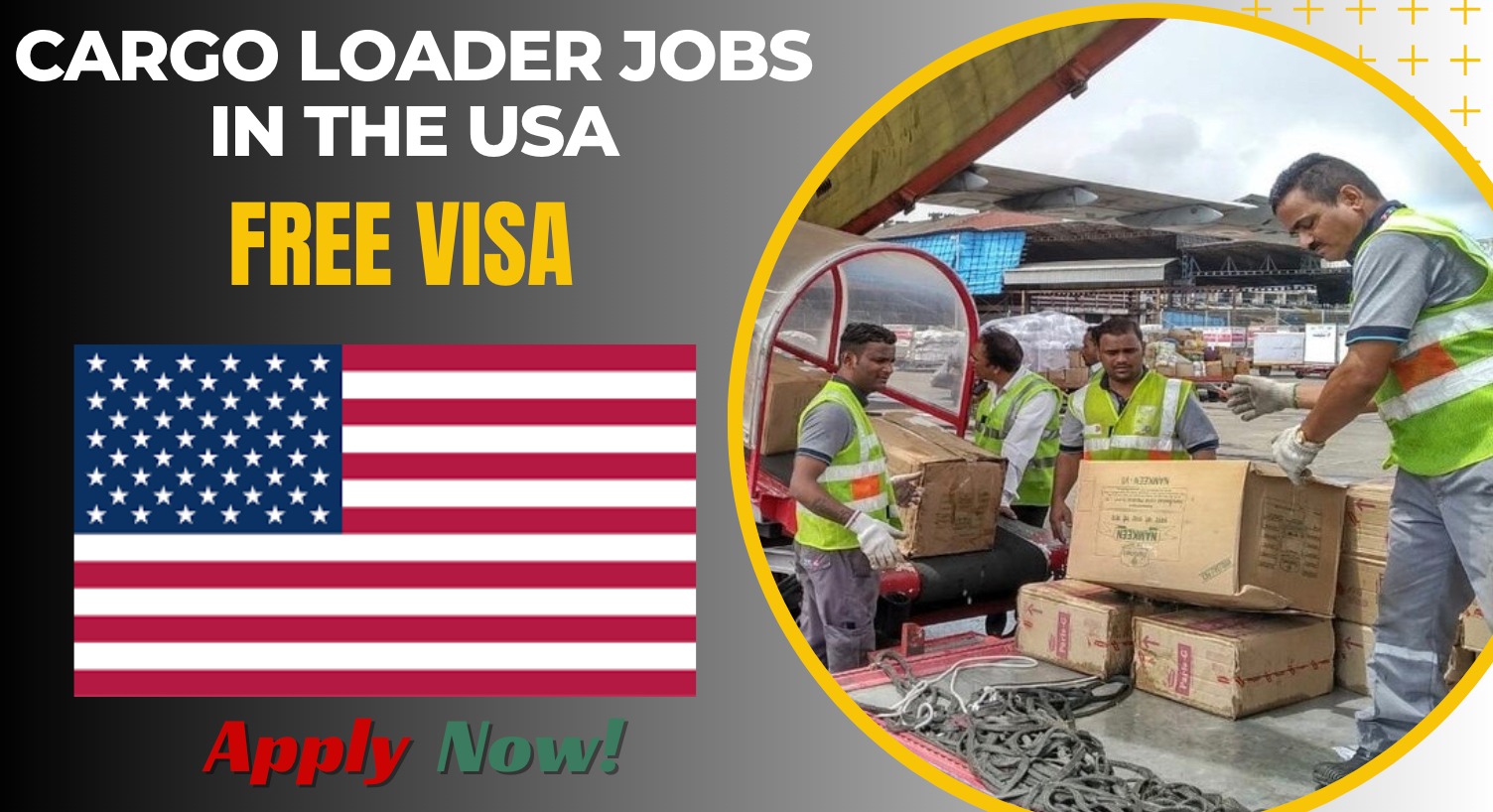
What Does a Cargo Loader Do?
Cargo loaders work in various environments—airports, warehouses, freight terminals, and distribution centers. The core job is moving freight, packages, and materials safely and efficiently.
Your daily responsibilities would include loading and unloading baggage, cargo, and mail from aircraft or trucks . You operate ground service equipment such as belt loaders, tugs, and bag carts . In warehouse settings, you move items using hand trucks, pallet jacks, and forklifts .
You prepare shipments by packing items into containers using protective materials to ensure safe transit . You maintain accurate shipment paperwork and inventory records . You also ensure work areas are clean and free of debris that could cause safety hazards .
The physical demands are significant. You need to be able to lift 50 to 75 pounds regularly, and in airport settings, push or pull carts weighing up to 300 pounds . You stand for extended periods, bend, stoop, kneel, and work in confined spaces like aircraft cargo bins . In airport roles, you work outdoors in all weather conditions—heat, cold, rain, and wind . Warehouse roles are typically indoors but may still involve long hours on your feet .
Visa Options for Cargo Loaders
This is the most important section. International applicants have two main visa pathways for cargo loader and material handler positions.
H-2B Visa: Temporary Non-Agricultural Work
The H-2B visa is a viable pathway for cargo loader positions, particularly in logistics and warehousing. This visa allows US employers to hire foreign workers for temporary non-agricultural jobs when there are not enough local workers available.
Real H-2B Cargo Loader Opportunities
A real example exists for a mover position in Springfield, Virginia that is essentially a cargo loader/material handler role . The position runs from February 1, 2026, under H-2B sponsorship, paying $21.04 to $21.16 per hour . The duties include moving household goods and office items, packing items into containers, and maintaining shipment paperwork—all core cargo loader functions .
This position has several features that make it attractive for international applicants:
No prior experience required—one month of training is provided
40 hours per week, Monday through Friday, 6:45 AM to 3:15 PM
Pre-hire background check and random drug testing, all fees paid by the employer
Ability to lift 75 lbs required
The 2026 H-2B supplemental rule has unlocked nearly 65,000 supplemental visas to help seasonal industries, explicitly naming transportation as a critical sector eligible for relief . These visas are released in three tranches throughout the year, creating multiple windows of opportunity .
Important H-2B Considerations
For airport-specific cargo loader roles (like ramp agents), the situation is different. Major airlines like Allegiant explicitly state: “Visa Sponsorship Available: No” for their Ground Operations Agent positions . The same applies to Allegiant’s Charter Ramp Representative positions . This means that for cargo loading jobs that are directly on the airport ramp for passenger airlines, sponsorship is generally not available.
However, the H-2B mover position demonstrates that cargo loader and material handler roles with logistics companies are indeed sponsorable . The key is to target logistics and moving companies rather than passenger airlines.
EB-3 Visa: Permanent Residency Path
The EB-3 visa is the pathway to permanent residency for cargo loaders seeking to settle in the USA long-term. This is an employment-based immigrant visa that leads to a Green Card and eventual citizenship.
Why EB-3 Works for Cargo Loaders
The EB-3 “Other Workers” category (also called unskilled workers) is for positions requiring less than two years of training or experience . Cargo loader and material handler roles fall squarely into this category. No college degree is required, and there is no formal English test requirement like IELTS or PTE . Basic English skills are sufficient .
What the EB-3 Visa Offers
You receive a ten-year Green Card for yourself. Your spouse and unmarried children under 21 can join you . Spouses can work independently without restrictions. Children under 21 receive free public education through grade 12. After five years as a Green Card holder, you can apply for US citizenship.
The EB-3 Process and Timeline
The EB-3 process involves several steps and takes considerable time. First, you need a permanent, full-time job offer from a US employer willing to sponsor you. The employer must obtain a PERM labor certification from the Department of Labor, demonstrating that there are no qualified US workers available for the position .
Second, once the labor certification is approved, the employer files Form I-140, Immigrant Petition for Alien Worker, with USCIS .
Third, and this is the critical part, you wait for your priority date to become current. For the EB-3 Other Workers category, the current backlog is approximately 8 years . This means from the time you file your application, you wait about 8 years before your priority date becomes current and you can actually travel to the US.
Important: The waiting period is in your home country
During this 8-year waiting period, you remain in your home country and can continue working and living normally . You do not travel to the US until your priority date becomes current. Many applicants use this time to learn English and prepare for their new life in America.
Real EB-3 Cargo Loader Opportunities
A real example of an EB-3 employer exists in the manufacturing sector. A trailer manufacturing company in the United States has been recruiting workers for assembly positions paying $18 per hour . The work involves assembling trailers—moving and securing large parts, using tools to fasten components, and performing quality checks. This is essentially a cargo loader/material handler role in a manufacturing setting.
The employer has 20-30 openings and offers a clear path: work for one year, and upon completion, the company sponsors your Green Card . The work environment is described as semi-automated with tool assistance—not heavy, back-breaking labor . Positions are available for both men and women, with lighter duties for those who prefer them .
Eligibility requirements include being under 50 years old, having no criminal record, and being physically capable of the work . No prior experience is required—training is provided on-site.
Why Airlines Do Not Sponsor for Ramp Roles
It is important to understand why airport ramp cargo loader positions with passenger airlines do not offer sponsorship. Allegiant, one of the major airlines, explicitly states in their job postings: “Must be authorized to work in the US as defined by the Immigration Act of 1986” and “Visa Sponsorship Available: No” . This is consistent across the industry for entry-level ramp and ground operations roles.
The reason is that these positions are not considered “temporary” in the way the H-2B program requires, and airlines prefer to hire workers who already have permanent work authorization. However, the logistics and moving company sector is different—they do participate in H-2B and EB-3 sponsorship programs.
Job Requirements You Need to Meet
Even for entry-level positions, employers have expectations. Here is what you need.
Basic Qualifications
You must be at least 18 years old . A high school diploma or GED is required for some positions , but not for others . No prior experience is required for many entry-level roles—employers provide on-the-job training . The H-2B mover position explicitly states “Experience Required: No” .
You must be able to pass a criminal background check and pre-employment drug screen . All background check and drug testing fees are paid by the employer .
Driver’s License
A valid driver’s license is required for many cargo loader positions, especially those that involve operating ground service equipment . The H-2B mover position requires a valid driver’s license .
Physical Requirements
The physical demands are significant. You need to be able to lift 50 to 75 pounds regularly, and in airport settings, push or pull carts weighing up to 300 pounds . You must be able to stand for extended periods, bend, stoop, kneel, climb, and work in confined spaces . In airport roles, you work outdoors in extreme weather conditions . In warehouse roles, you work indoors but still face long hours on your feet .
Language Skills
Basic English proficiency is required to receive instructions and ensure safety . However, there is no formal English test requirement like IELTS or PTE for EB-3 sponsorship . The H-2B mover position requires the ability to understand instructions but does not specify a test .
Age Requirements
For EB-3 sponsorship, applicants are typically accepted up to age 50 . The trailer manufacturing employer specifies this age limit .
Work Schedule Flexibility
Cargo loader positions often require flexible schedules. The H-2B mover position requires 40 hours per week, Monday through Friday, with weekends and overtime possible . Airport roles often require nights, weekends, and holidays .
Finding Cargo Loader Jobs with Sponsorship
Finding the right employer takes strategy. Here is practical advice based on real opportunities.
Target H-2B Logistics Positions
Focus your search on job boards that list H-2B positions. The U.S. Department of Labor’s Seasonal Jobs website (seasonaljobs.dol.gov) is the official source. The H-2B mover position in Springfield, Virginia was listed through Visa Sponsor Jobs . Use keywords like “H-2B mover,” “H-2B material handler,” and “H-2B cargo loader.”
Target logistics and moving companies rather than passenger airlines. AEM, Inc. in Springfield, Virginia is a real example of a company sponsoring H-2B for mover positions .
Target EB-3 Sponsorship Programs
For permanent residency, work with a reputable immigration consultant who has direct relationships with sponsoring employers. The trailer manufacturing company mentioned is actively recruiting through EB3Home . These consultants can help you find legitimate employers and guide you through the process.
What to Watch Out For
Be cautious of any job posting that asks you to pay money upfront for visa processing. Legitimate sponsors never ask workers to pay for visa filing fees . The employer bears these costs.
Be wary of promises of a “fast track” to a green card. The EB-3 Other Workers category has an 8-year backlog . Any promise of a faster path is a red flag.
Do not waste time applying to passenger airline ramp positions that require existing work authorization. Allegiant’s Ground Operations Agent and Charter Ramp Representative positions explicitly state they do not offer sponsorship . Focus only on logistics companies and EB-3 employers.
For Those Already Authorized to Work
If you already have a Green Card, EAD, or other lawful permanent work authorization, you can apply directly to airport ramp positions. Allegiant Air is hiring Ground Operations Agents in Punta Gorda, Florida at $16 per hour with full benefits including flight privileges . Charter Ramp Representative positions in Las Vegas pay $375-$425 per trip after training . These positions require existing work authorization but offer excellent benefits.
Worker Rights and Protections
If you come to the USA as a cargo loader, understand your rights. All workers in America, regardless of immigration status, have legal protections under federal and state laws.
You have the right to be paid at least minimum wage. For hours worked beyond forty in a week, you must be paid overtime at one and a half times your regular rate.
You have the right to work in a safe and healthy environment. Your employer must provide safety training, necessary protective equipment, and follow OSHA standards.
If you work under the H-2B visa, your employer has additional obligations. They must reimburse you for visa processing fees in the first workweek . They must provide or pay for transportation to and from the worksite upon completion of 50% of the contract . They must guarantee to offer work for hours equal to at least three-fourths of the workdays in each 12-week period .
If you work under the EB-3 visa, your employer must adhere to the terms of the labor certification, including paying at least the prevailing wage . PERM costs must be borne by the employer, not the worker .
Do not accept work on a tourist visa. Using a tourist visa to work is illegal and considered visa fraud. It can result in deportation and a ban from entering the USA.
Step-by-Step Action Plan
If you are serious about pursuing a cargo loader job in the USA with sponsorship, here is a practical roadmap.
Step One: Determine Your Visa Pathway
If you are seeking temporary work, the H-2B visa is your best option. Real H-2B mover positions are available in Virginia at $21 per hour . If you are seeking permanent residency and eventual citizenship, the EB-3 visa is the path to pursue, though you must be prepared for an approximately 8-year waiting period .
Step Two: Gather Your Documents
Prepare your documents in advance. You need a valid passport with at least 12 months validity. Obtain a police clearance certificate. Prepare for a physical examination and TB test. If you have a driver’s license, ensure it is valid. For EB-3, you need to be under 50 years old .
Step Three: Work with a Reputable Consultant
For EB-3 sponsorship, work with a reputable immigration consultant who has direct relationships with sponsoring employers. The trailer manufacturing employer mentioned recruits through EB3Home and MaxChuguo . They can help you find legitimate employers and guide you through the PERM labor certification process.
Step Four: Target H-2B Logistics Employers
For H-2B, focus your search on logistics and moving companies. AEM, Inc. in Springfield, Virginia is a real example . Search the Department of Labor’s Seasonal Jobs website for “mover” and “material handler” positions.
Step Five: Prepare Your Application
Make sure your resume highlights any physical labor, warehouse, or driving experience. Emphasize your ability to lift 50-75 pounds, your reliability, and your willingness to work flexible hours. Your cover letter should demonstrate your work ethic.
Step Six: Apply Through Official Channels
For H-2B positions, apply through the channels specified in the job posting. For the mover position, apply through the link provided . For EB-3, work through the consultant who will connect you with the employer.
Step Seven: Be Patient
The H-2B process takes several months from application to travel. The EB-3 process takes approximately 8 years of waiting before travel . Do not quit your current job or make major life changes until you have your visa approved.
Final Thoughts
Cargo Loader Jobs in the USA with Visa Sponsorship: Cargo loader jobs in the USA with visa sponsorship are real opportunities, but you need to know where to look. The H-2B visa provides a pathway for temporary work with logistics and moving companies—a real position in Virginia is currently available at $21 per hour . The EB-3 visa offers a permanent path to a Green Card for those willing to wait approximately 8 years and work with an employer like the trailer manufacturing company offering $18 per hour assembly positions .
The critical distinction is that passenger airlines like Allegiant do not sponsor visas for entry-level cargo loader roles . Their Ground Operations Agent and Charter Ramp Representative positions require existing work authorization . However, logistics companies, moving companies, and manufacturing employers do participate in sponsorship programs.
If you have existing work authorization, you can apply directly to airport ramp positions with excellent benefits including flight privileges . If you need sponsorship, focus on H-2B opportunities with logistics employers or EB-3 programs with manufacturing companies .
Start by determining which visa pathway fits your long-term goals, gathering your documents, and working with reputable consultants for EB-3 or targeting H-2B job postings on official government sites. The road requires patience, but for those who are willing to work hard and follow the legal process, the opportunity to build a new life in America through cargo loading work is within reach.
Disclaimer
This job information is shared for educational and informational purposes only.
Any discussion of visa categories is based on general immigration laws and publicly available information